


Slight alterations in vision should never be neglected. It’s very important to get yourself checked by trained optometrists and specialist and get your eyes evaluated. Uncorrected refractive errors can lead to impaired development of vision in children leading to amblyopia or lazy vision and squinting of eyes.
Refractive errors in the eye are of 3 types:
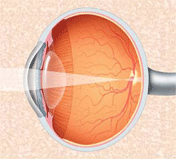
Refers to a state of the eye, wherein the rays of light coming from a distant target, get focused at a point in front of the retina. In this situation, minus powered glasses or contact lenses are necessary to focus this image onto the retina.
Hyperopia or long-sightedness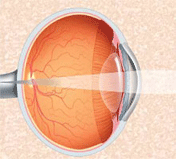
Refers to a state of the eye, wherein the rays of light coming from a distant target, get focused at a point behind the retina.In this situation, plus powered glasses or contact lenses are necessary to focus this image onto the retina.
Astigmatism or cylindrical power
Refers to a state of the eye, wherein the rays of light coming from a distant target, cannot focus at a single point on the retina. In this situation, special lenses of different curvature are required to focus the light onto the retina.
Various methods to correct refractive errors
Spectacles Contain lenses that alter the incoming rays of light to enable them to focus on the retina.
Contact Lenses perform the same function as spectacles but are placed in the cornea. They provide improved cosmesis and better quality of vision, especially for higher refractive errors.
In the Calvary Eye clinic trained optometrists to perform refraction aided with autorefraction, keratometry and corneal topography. Contact lens fitting is done for both soft and semi-soft lens.
LASIK is an exciting surgical procedure that is capable of correcting a wide range of nearsightedness (myopia), farsightedness (hyperopia) and astigmatism. LASIK is the acronym for laser-assisted in-situ keratomileusis. The name refers to the use of a laser to reshape the cornea without invading the neighbouring cell layers. Lasik is currently the most commonly performed refractive procedure in the United States and in India. Lasik has been performed internationally for approximately 10 years.
It was first performed in clinical trials in the US in 1991. It was officially approved in 1996 in the U.S. It is important to note that the major components of the procedure have a long history. Ophthalmologists have been reshaping the cornea for over 50 years creating a protective layer of tissue for over 35 years and using the excimer laser since the 1980s.
It was first performed in clinical trials in the US in 1991. It was officially approved in 1996 in the U.S. It is important to note that the major components of the procedure have a long history. Ophthalmologists have been reshaping the cornea for over 50 years creating a protective layer of tissue for over 35 years and using the excimer laser since the 1980s.
Photo Refractive Keratectomy (PRK)
In this procedure, the laser treatment is directly performed on the surface of the cornea to
reshape it for correction of refractive errors. This is usually performed for people with smaller refractive errors. The surface layer usually takes 3-4 days to heal and the vision gradually improves thereafter.
Laser in Situ Keratomileusis (LASIK)
This procedure involves first creating a thin flap of the cornea with an instrument called the microkeratome. Followed by the lifting of the flap and laser treatment to reshape the cornea. The flap is then repositioned in its original place. Improvement in vision is noted right from the next day.
The beam profile of Wave light laser has been wavefront-optimized, hence it removes a lesser amount of corneal tissue when compared to other laser machines, thus making the treatment safer for your eyes. Wavefront optimization also ensures that you do not experience any
glare or halos during the night while looking at bright lights. Wavelight laser allows multiple options for customized treatments, such as wavefront-guided, topography-guided, Q factor guided treatments. Such treatment modalities are far superior when compared to those with other lasers such as zyoptix, custom vue, or custom cornea.
Both PRK and LASIK procedures are absolutely painless and are performed as an outpatient procedure using topical anaesthetic eye drops. The entire procedure lasts for only 10 –15 minutes and you will be awake during the entire procedure. During the treatment, you are required to look at a fixation light while the laser is performed and you will also hear the noise of the laser machine during the treatment.
The actual laser treatment only lasts for 15 to 45 seconds. Following the treatment, you can return home immediately. However, you should make arrangements for a friend or relative to take you home after the procedure.
After going through our site there will be many doubts rising in your mind. We have tried to answer a few general questions for more details you can contact us we will be more than happy to be of assistance to you